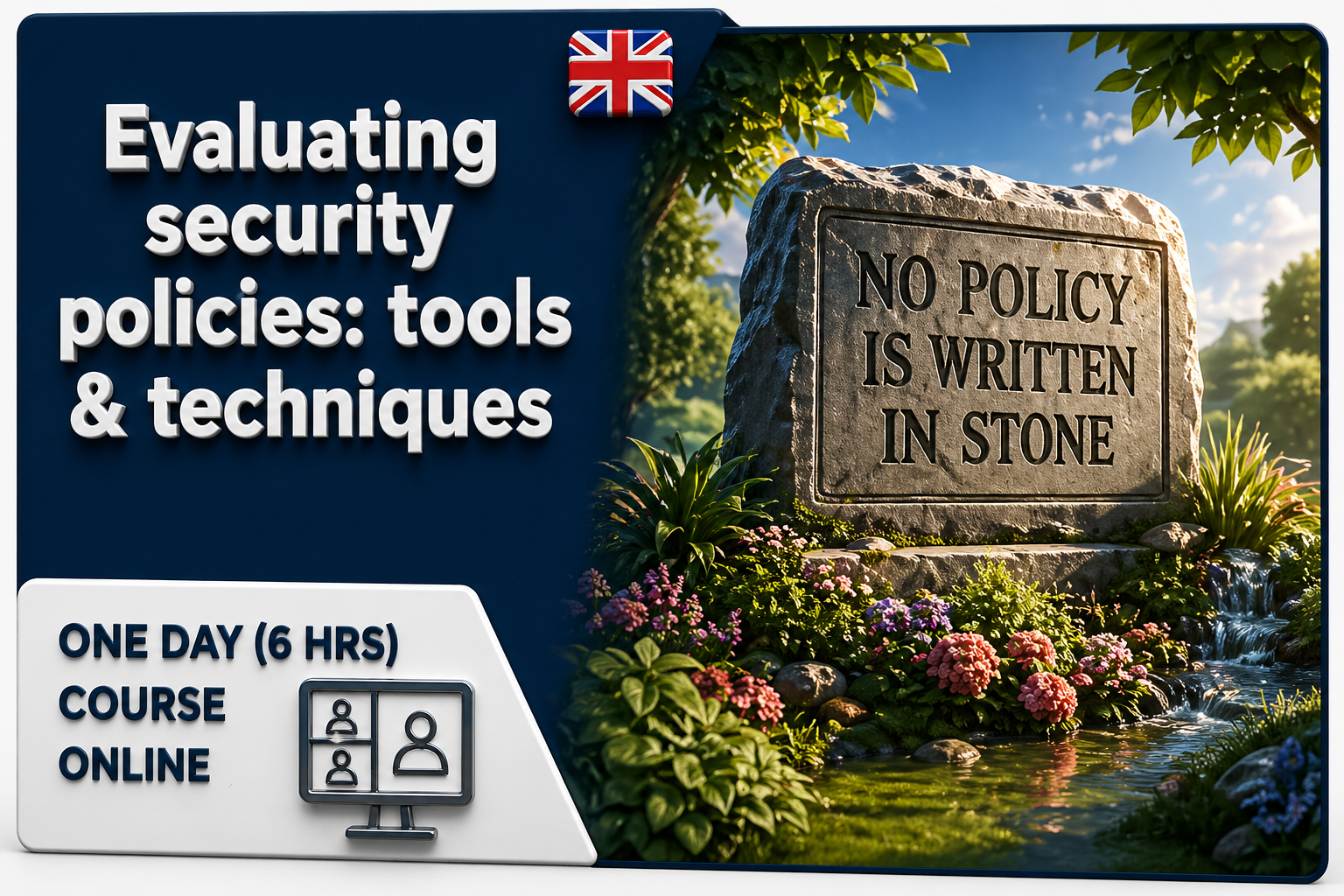
Evaluating security policies: tools & techniques
Duration: 1 days / 6 hours
Delivery method: Online (Zoom or Teams)/ In-company training
Target Audience: This course is designed for security professionals who want to learn tools and techniques for evaluating security policies to ensure they are aligned to their business.
Cost: Available upon application
Language: English
Course code: ESP-1
Introduction
Security policies establish a structured framework to protect sensitive information and ensure the integrity of operations. They clearly define rules for handling data and access, and they also guide responses to security incidents. This approach helps lower the likelihood of breaches that could cause financial loss, legal issues, and reputational harm.
By evaluating security policies with the tools and techniques described here, you can promote greater accountability among employees and ensure everyone understands their role in protecting assets. As threats grow more sophisticated, strong policies become increasingly vital. They maintain trust with customers and partners and help keep business operations running smoothly, even during disruptions.
With this in mind, develop practical skills to assess and improve security policies using proven tools and techniques. Learn how to identify gaps, ensure compliance, and reduce risks. By doing so, you’ll gain the knowledge to make informed decisions and strengthen your organization’s security posture.
What You’ll Learn
 Understand the principles of policy evaluation in an aviation security context Identify what makes a policy or procedure effective, measurable, and scalable Use practical tools like Theory of Change, baseline indicators, and before-after comparisons Apply evaluation techniques such as Difference-in-Differences (DiD) and Interrupted Time Series (ITS) to policies, enhancing security through a variety of techniques Anticipate and address ethical, safety, and operational concerns in evaluation Present findings to internal leadership, regulators, or external auditors in a clear, evidence-based way Use evaluations to support continuous improvement, compliance, and risk mitigation
Potential course benefits, the why
Explore structured approaches to evaluate compliance, coverage, and enforcement of security policies.
Learn how to detect policy weaknesses and misalignments with organizational or regulatory requirements.
Understand how security policies translate into technical controls and how to measure their impact.
Learn how to spot vague, outdated, or unenforceable language in security policies.
Discover how effective policy evaluation directly contributes to reducing risk exposure.
Use metrics and KPIs to move beyond checklists and into meaningful performance evaluation.
Who should attend
This course suits security professionals, security managers, and policy-makers. It targets anyone managing or implementing security protocols. You can improve existing measures or create new policies with this course, incorporating evaluating security policies tools & techniques to provide essential knowledge for effective security management.
Why baselining security policies matters
Baselining security policies is not just about compliance—it’s about creating a proactive, resilient security posture that can withstand the complexities of today’s digital threats. By the end of this course, you will be equipped with the skills to not only protect your organization’s data but also to foster a culture of security awareness and responsibility, aligned with evaluating security policies using innovative approaches and techniques.
"A policy is only as strong as the questions it survives."
Continue Looking: