Enhancing feedback into security
Duration: 1 days / 6 hours
Delivery method: Online (Zoom ↗️ or Teams ↗️)/ In-company training
Target Audience: This course is designed for security professionals who play a role in promoting and fostering a security-conscious culture their organisation.
Cost: Available upon application
Language: English
Course code: EFS-1
Introduction
Welcome to “Enhancing Feedback in Security,” a comprehensive course designed to elevate your understanding of how feedback can be a powerful tool in improving security practices, policies, and systems. In today’s rapidly evolving digital landscape, security isn’t just about tools and technology; it’s about creating a feedback-driven culture that strengthens resilience, adaptability, and awareness across every layer of an organization.
What you will learn
Through this course, you’ll explore the essential components of an effective security feedback loop and discover how real-time insights, structured polling, constructive critique, and continuous improvement can transform your approach to safeguarding data and infrastructure. You’ll gain practical skills in:
Learn how to establish policies that evolve with emerging threats and user behaviour, keeping systems aligned with the latest in security best practices.
Gain a practical understanding of how structured polling, rapid pulse checks, and short-form questionnaires can be used to monitor security culture, identify awareness gaps, and detect early behavioural risks. Learn how to design meaningful poll questions, interpret response patterns, and integrate results into your wider security feedback system. By applying these techniques, you will be able to measure shifts in security attitudes, track the effectiveness of training, and proactively improve how your organisation responds to user behaviour, emerging threats, and cultural indicators.
Use data analytics to measure the effectiveness of security interventions and inform decision-making, focusing on refining practices that maximize protection.
Improve security awareness among team members and stakeholders by making feedback an integral part of their daily interactions with security systems.
Dive into incident analysis techniques that emphasize honest and constructive feedback, allowing teams to learn and improve from every experience.
By the end of the course, you’ll use actionable tools—including polling frameworks, feedback analysis methods, and security communication models—to enhance security feedback mechanisms and strengthen your organisation’s culture.
You’ll build a more adaptive, engaged, and security-conscious environment.
Whether you’re a security professional, team leader, or policy maker, this course equips you with essential, practical skills.
It also guides you in transforming feedback into a powerful catalyst for continuous security improvement.
The final module brings everything together with a step-by-step guide to creating a Security Feedback Action Plan.
Why polling is included in this course
Polling is a key component of modern security feedback systems because it provides fast, measurable insight into how people perceive, understand, and practice security across an organisation. While traditional feedback reveals individual experiences, polling captures broader trends—showing what employees know, how they behave, and where risks may be forming.
By including polling in this course, participants learn how to use short pulse checks, awareness polls, and sentiment surveys to monitor culture, identify vulnerabilities early, and measure the impact of security initiatives. Polling helps turn scattered perceptions into actionable data, enabling more accurate decision-making, stronger engagement, and a more resilient security culture.
Potential course benefits, the why
Effective security is not only reactive but proactive. By enhancing feedback processes, you’ll learn to identify weaknesses, adapt policies, and address threats before they become incidents. A proactive feedback culture keeps your organization agile and responsive, setting you ahead in the cybersecurity field.
Creating a culture where feedback is welcomed, analyzed, and actioned can have a profound impact on an organization’s overall security posture. This course helps you implement systems where security practices continuously evolve, and your team actively contributes to improving defenses.
Feedback-driven security helps build a more knowledgeable and aware workforce. By engaging team members in security feedback, they become more involved in identifying risks and recognizing threats. This increased security awareness creates a more robust line of defense across all organizational levels.
Learn how to turn polling results and feedback data into clear, evidence-based security decisions. Understand how to spot trends, prioritise risks, and refine policies using insights that directly strengthen your organisation’s security posture.
Security policies that rely on feedback are more adaptable to emerging threats and shifts in user behavior. With a feedback-enhanced approach, you’ll learn to adjust policies in real-time, keeping them relevant and effective as technology, regulations, and threats evolve.
A culture of open feedback supports a more transparent and accountable security practice, which is increasingly important for regulatory compliance. By ensuring your team is engaged in regular feedback, you demonstrate to stakeholders and auditors that you prioritize risk management, security awareness, and adaptive policies.
Learn how to combine numerical polling data with open feedback to uncover meaningful patterns in behaviour, culture, and risk. Understand how these insights help highlight emerging issues and guide targeted security improvements.
Differences between internal and external feedback
Feedback – internal
Often delivered in formal settings such as annual reviews, performance feedback focuses on an employee’s individual contributions and how well they meet their role expectations.
This type of feedback is shared among colleagues and team members. Peer feedback can provide valuable insights, helping individuals improve by leveraging the observations of those who work closely with them.
Feedback from a manager to an employee to provide guidance, identify strengths and weaknesses, and help align individual performance with team and company goals.
Individuals reflecting on their own performance, often part of structured review processes where employees assess their work, progress, and goals before receiving feedback from others.
Informal and immediate feedback provided during or immediately after tasks or projects. It helps address issues as they arise, allowing for quick adjustments and learning.
Discover how quick, targeted internal polls can reveal real-time insights into employee awareness, cultural attitudes, and day-to-day security behaviours. Learn how to use pulse checks to spot emerging risks, measure engagement, and support continuous improvement in your security environment.
Feedback – external
Input from customers regarding their satisfaction with a product or service. This can be gathered through surveys, reviews, focus groups, or direct communication. Customer feedback is essential for understanding the market’s reception and identifying potential areas of improvement.
Broader than individual customer input, market feedback reflects trends, preferences, and needs across the industry or market segment. This can come from market research, competitive analysis, or industry reports.
Feedback from suppliers and partners in the supply chain can highlight efficiencies, areas for cost savings, or opportunities for improvement in procurement and production processes
Feedback from investors, board members, or other stakeholders who have a vested interest in the company’s performance and direction. This type often focuses on long-term strategic outcomes, profitability, and operational efficiency.
Information and opinions from public-facing sources, including media coverage, social media, and public forums. This feedback can shape a company’s public image and influence how the brand is perceived in the broader community.
Learn how external polls can provide valuable insight into how customers, partners, and the public perceive your organisation’s security posture. Understand how to use these sentiment trends to strengthen trust, address concerns, and guide strategic security decisions.
Types of polling
Short, frequent polls designed to take a quick snapshot of security culture, attitudes, and awareness. They help identify early shifts in behaviour or sentiment.
Polls that measure how well employees understand security policies, threats, and procedures. Useful for identifying knowledge gaps that training needs to address.
Focuses on what employees actually do, not just what they know. Helps detect risky habits, workarounds, or deviations from security best practices.
Assesses whether staff feel safe reporting issues or raising concerns. Highlights trust levels, psychological safety, and willingness to engage with security teams.
Checks how employees view leadership’s commitment to security. Determines whether leaders model secure behaviour and support a strong security culture.
Explores how time pressure, fatigue, or resource shortages influence security decisions. Helps identify when operational strain increases risk-taking.
Conducted after security events or near misses to assess clarity, speed, and usability of the response process. Provides insights for improving incident handling.
Measures whether training was effective, relevant, and understood. Helps evaluate improvements in confidence and capability.
Evaluates whether security policies support or hinder daily work. Provides feedback on usability, fairness, and practical challenges.
Broader surveys that assess cultural alignment with security values, norms, and expectations across teams or departments.
Collects opinions from customers, partners, or the public on trust, security reputation, or perceived risk. Useful for strengthening transparency and external confidence.
Best practice: Use polling + feedback together
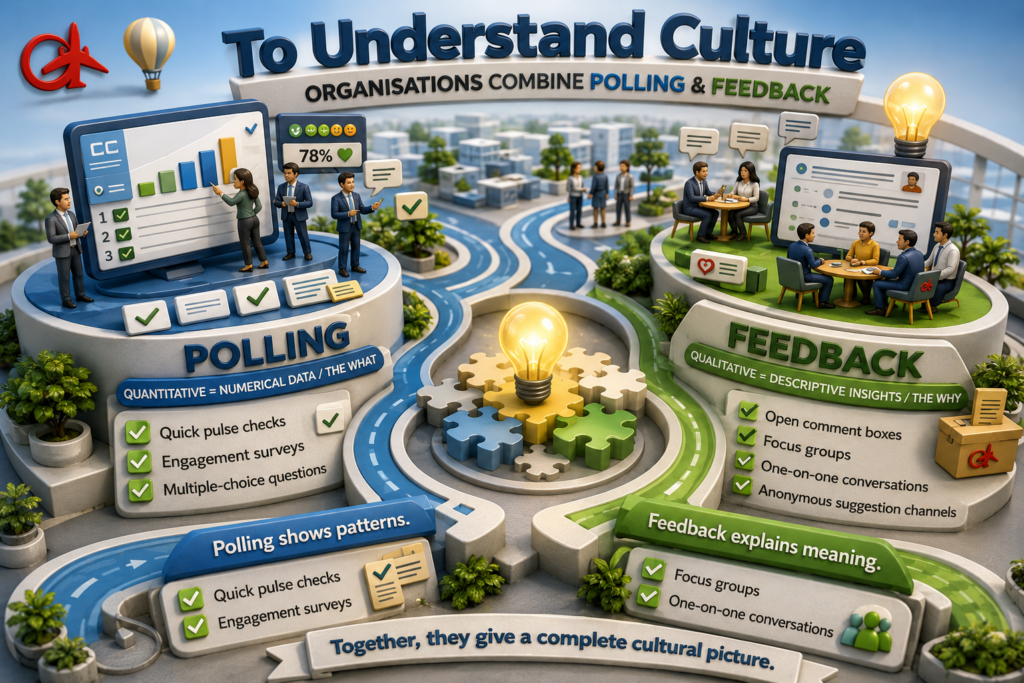
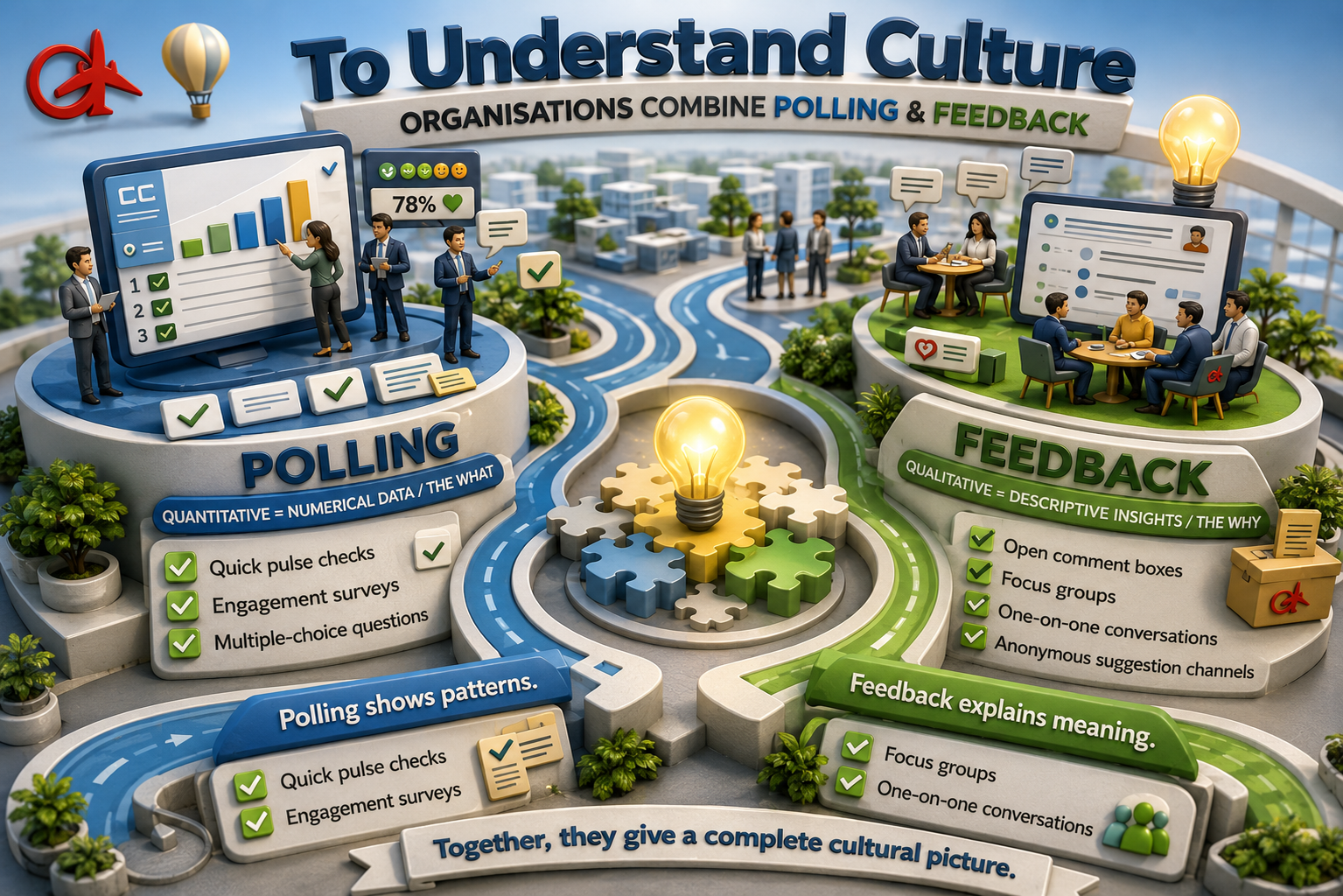
To truly understand culture, organisations typically combine:
1. Polling (quantitative = numerical data / the what)
Quick pulse checks
Engagement surveys
Multiple-choice questions
2. Feedback (qualitative = descriptive insights / the why)
Open comment boxes
Focus groups
One-on-one conversations
Anonymous suggestion channels
Polling shows patterns.
Feedback explains meaning behind the patterns.
Together, they give a complete cultural picture.
“Polling shows the pattern; feedback explains the reason.”
In-house courses
Zoom ↗️ is a default setting for this course, it could be delivered via Microsoft Teams ↗️ or Webex.
Jump to internal page: Contact us ↗️